What Is Kakuni? Japanese Braised Pork Belly Explained — and Where to Eat It in Tokyo
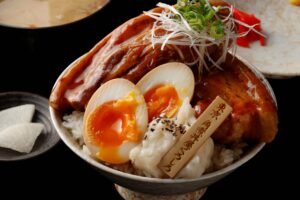
Quick answer: Kakuni (角煮, “square-simmered”) is Japanese pork belly cut into thick blocks and simmered for hours in soy sauce, sugar, sake and dashi until it is soft enough to split with chopsticks. It is sweet-savory rather than spicy, and it is usually eaten on its own or over rice as kakuni don. In Tokyo, you can try it at Kakunidon-ya Kuroshiro in Takadanobaba — a restaurant that serves nothing but kakuni, two train stops from Shinjuku.
What is kakuni?
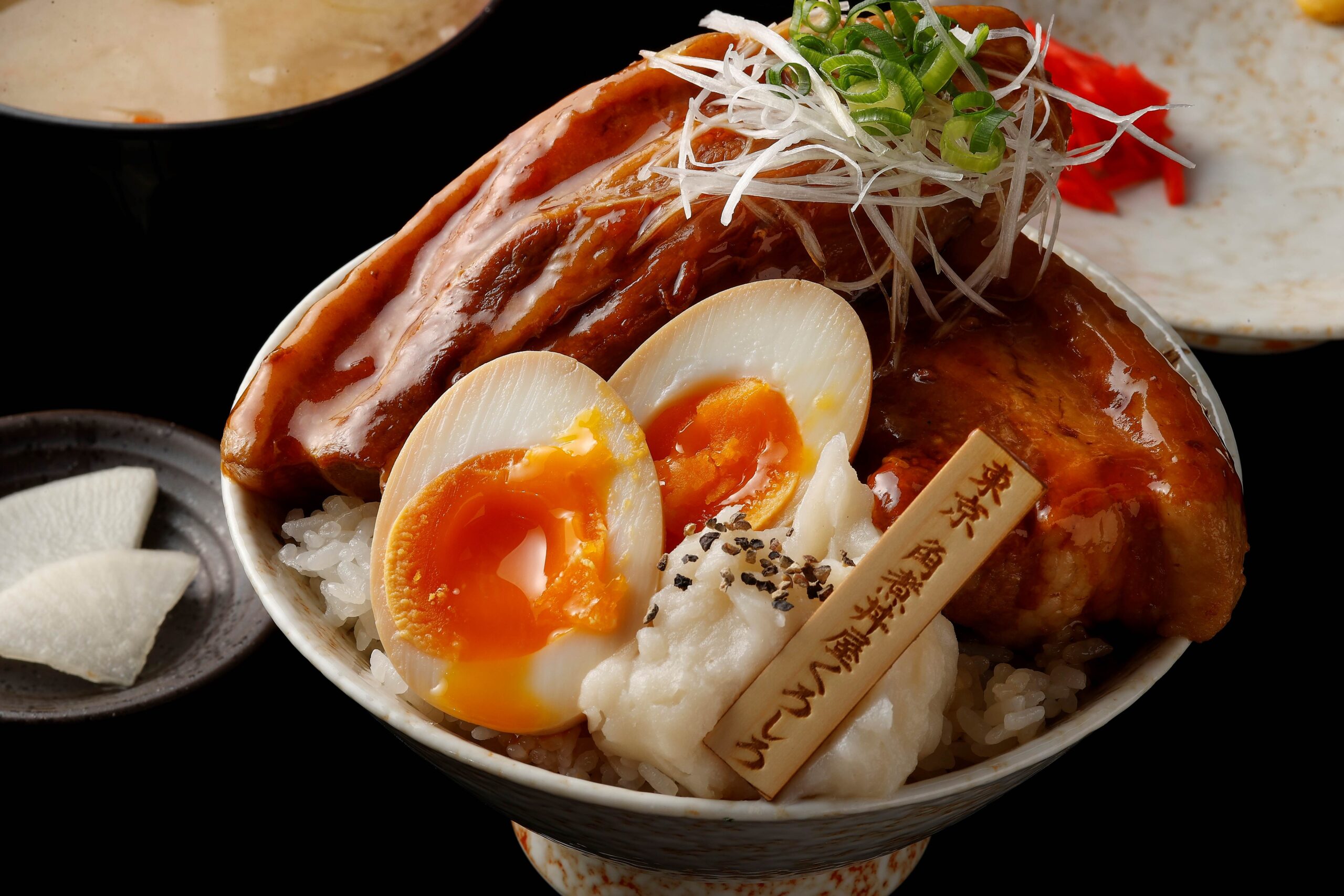
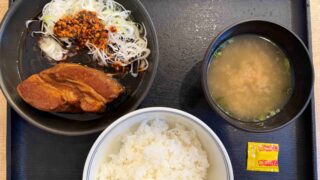
Kakuni is one of Japan’s classic home-style meat dishes. A slab of pork belly — layers of lean meat and fat — is cut into large cubes, boiled to remove excess fat, and then slowly simmered in a seasoned broth. The long, gentle cooking turns the fat silky and the meat tender, while the broth reduces into a glossy, sweet-and-salty glaze.
- Cut: pork belly (bara), cut into thick blocks
- Typical seasoning: soy sauce, sugar, mirin, sake, often with dashi and ginger
- Texture: very soft — a good kakuni breaks apart with chopsticks alone
- Flavor: sweet-savory and rich, not spicy
- How it’s served: as a side dish, with Japanese mustard, or over rice (kakuni don)
Where does kakuni come from?
Kakuni is closely associated with Nagasaki, the port city that traded with China for centuries. It is generally said to have developed from Chinese braised pork such as dongpo pork, adapted to Japanese tastes with soy sauce and dashi. Okinawa has a cousin called rafute, simmered with the local spirit awamori. Today kakuni is found all over Japan — in izakaya, set-meal restaurants and home kitchens — but restaurants that specialize in it are rare.
Kakuni vs. chashu vs. Chinese braised pork
| Kakuni (Japan) | Chashu (ramen pork) | Dongpo pork / hong shao rou (China) | |
|---|---|---|---|
| Cut | Thick blocks of pork belly | Rolled belly or shoulder, sliced thin | Square blocks of pork belly |
| Seasoning | Soy sauce, sugar, sake, dashi | Soy-based braise or roast | Soy sauce, rice wine, rock sugar; often star anise or other spices |
| Eaten as | A main dish or over rice | A ramen topping | A main dish with rice |
| Character | Lighter, dashi-forward, sweet-savory | Savory, meant to complement soup | Deep, aromatic, often spiced |
If you love Chinese red-braised pork or Taiwanese braised pork rice, kakuni will feel familiar — but cleaner and more delicate, because Japanese kakuni usually relies on dashi rather than strong spices.
How to eat kakuni don
- Split it with your chopsticks. A well-made block should come apart without a knife.
- Eat a bite of pork with rice and sauce. The glaze soaks into the rice — that’s the point of the bowl.
- Change the flavor halfway. Soft-boiled egg, pickled red ginger or a rich garlic sauce keep the last bites interesting.
- Finish with soup. In Japan, kakuni don is often served as a set meal with miso soup.
Where to eat kakuni in Tokyo: a restaurant that serves only kakuni
Kakunidon-ya Kuroshiro is a small restaurant in Takadanobaba, Shinjuku City, that serves just one thing: kakuni. In 2023 the English-language site SoraNews24 introduced it as Tokyo’s one and only kakuni bowl specialist, and it has also appeared on Japanese TV and YouTube.
- 15+ hours of preparation: each batch of pork is prepared over 15 hours or more (up to about 18 hours, depending on the day’s volume).
- Brand pork: we use Waton Mochibuta, a Japanese brand pork.
- Big portions: about 200 g of braised pork per bowl (weight after simmering), on 200 g of Tsuyahime rice from Yamagata.
- Japanese-style broth: seasoned with kombu and bonito dashi — no star anise.
- Gluten-free: our Kakuni Don is certified gluten-free by an inspection agency (some menu items are not covered — please ask our staff when ordering).
What to order
| Dish | Price (tax incl.) | What you get |
|---|---|---|
| Kakuni Don Set Meal (most popular) | ¥1,900 | About 200 g of braised pork over rice, soft-boiled egg, mashed potatoes, green onion, red ginger, pork miso soup |
| Premium Kakuni Don Set Meal | ¥3,000 | Two whole blocks of braised pork. Leftovers can be taken home (container ¥50) |
| Kakuni Don with Trimmed Pork | ¥1,300 | Same recipe and sides, made with irregularly shaped trimmings |
Popular add-ons include torched cheese (¥300), homemade tartar sauce (¥300) and our special rich garlic sauce (¥200). See the full menu.
Hours, location and reservations
- Address: 1F Takadanobaba Prince Mansion, 4-17-17 Takadanobaba, Shinjuku-ku, Tokyo
- Access: 4 min walk from JR Takadanobaba Station (Toyama Exit), 6 min from the Tokyo Metro Tozai Line (Waseda Exit). Takadanobaba is two stops from Shinjuku on the JR Yamanote Line.
- Hours: 11:00–15:00 (last order 14:30). Open every day. We close early when we sell out.
- Payment: cash or PayPay only (credit cards are not accepted).
- Seating: 8 counter seats plus two tables for 4.
- Ordering: order directly with our staff (no ticket machine).
- Busiest time: 12:00–13:00, with a wait of up to about 15 minutes.
- Reservations: book a table online in English — same-day booking is possible. Reserve here
Getting here: Access & map
Coming from Shinjuku? See our step-by-step guide: Craving meat near Shinjuku? Where to eat kakuni don in Takadanobaba.
FAQ
Is kakuni spicy?
No. Kakuni is sweet and savory. If you want more punch, add garlic sauce or red ginger.
Is kakuni the same as chashu?
No. Chashu is thinly sliced pork for ramen. Kakuni is thick blocks of pork belly simmered until very soft and eaten as a main dish.
Is kakuni gluten-free?
Most kakuni is made with regular soy sauce, which contains wheat. At Kakunidon-ya Kuroshiro, the Kakuni Don is certified gluten-free by an inspection agency. Some menu items are not covered, so please check with our staff when ordering.
Is kakuni halal?
No. Kakuni is made from pork.
How much is kakuni don in Tokyo?
Prices vary by restaurant. At Kakunidon-ya Kuroshiro, the Kakuni Don Set Meal is ¥1,900 including tax.
Do I need a reservation?
Walk-ins are welcome, but we can sell out. Booking online guarantees your seat.
Do you accept credit cards?
No. We accept cash and PayPay only.
How long is the wait?
Our busiest time is 12:00–13:00, and the wait is up to about 15 minutes. Come before noon or after 13:00, or book online to skip the wait.
Can I eat alone?
Yes. We have 8 counter seats, perfect for solo diners. Groups of up to 4 can sit at one of our two tables.
Want to try real kakuni in Tokyo? Book a table at Kakunidon-ya Kuroshiro — two stops from Shinjuku.

- 代表取締役
-
株式会社A-S(エース不動産)を創設し、現在に至る。
オウンドメディア運営(コラム ・YouTube ・TiKToK 配信等)、経営・財務戦略策定、マーケティング運営全般を担当。
2023年、自身のマーケティング能力を使い、飲食店集客を新規事業の軸としつつ、自身で直接お客様のニーズを掴むために先頭に立ち飲食の店舗運営をする。
Latest entries
 Kakuni Guide2026年11月24日Takadanobaba Restaurants: 5 Lunch Spots Near the Station (2026 Guide)
 Kakuni Guide2026年10月15日Kakuni Recipe Without a Pressure Cooker: Japanese Braised Pork Belly from a Kakuni Specialist
 Kakuni Guide2026年10月10日Gluten-Free in Tokyo: Lab-Tested Gluten-Free Kakuni Don (Japanese Braised Pork Bowl)
 Kakuni Guide2026年10月9日Yoshinoya Kakuni Review: Thick-Cut Braised Pork Set Meal, Rated by a Kakuni Specialist
\ 最新情報をチェック /